

How long does it take to get blog traffic? Many new blogs need at least three to six months to begin seeing meaningful signs of growth, and six to twelve months or longer before search traffic becomes more consistent.
Some blogs grow sooner, while others take longer, depending on the niche, content quality, competition, indexing, and just how well the posts answer real search questions.
A realistic expectation often looks like this:
- 0–3 months: Crawling, limited indexing, few impressions and almost no clicks
- 3–6 months: More pages indexed, early impressions, occasional clicks
- 6–12 months: Rankings may improve, leading to more noticeable organic traffic
- 12 months and beyond: Traffic may grow more steadily as the site builds a larger library of useful, related content and improves the posts already showing potential.
The Myth vs. Reality
You will hear claims like:
- “I got 10,000 visitors in 30 days.”
- “This one trick doubled my traffic overnight.”
Those results may happen, but they are not typical.
What you usually do not see are the months of planning, publishing, updating, and waiting that came before the traffic increase.
The reality is that most new blogs go through a period when very little seems to be happening. Pages may receive only a few impressions, clicks may be rare, and growth can feel almost invisible.
This is also where many bloggers stop.
Consistency matters during this stage, but consistency does not mean publishing endlessly without a plan. It means continuing to create useful content, reviewing what the search data shows, and improving the posts that have the best chance of growing.
Learning how to stay consistent with content creation can help you keep publishing without burning yourself out or abandoning the blog before it has had enough time to gain traction.
Month 1: Building the Foundation
During your first month, traffic from Google will probably be limited.
You may notice:
- Some posts have not been indexed yet
- Your pages receive few or no impressions
- Clicks are rare
- Traffic remains close to zero
This is often the point where new bloggers begin questioning everything.
Should I change my niche?
Are my posts good enough?
Am I doing something wrong?
A new website usually has little search history, few external links, and only a small collection of related content. Google may still be crawling your pages, deciding which ones to index, and determining which search queries they are relevant for.
That does not automatically mean your blog has a serious problem. It means your website is still giving Google information about what it covers and who the content may help.
During this stage, focus on the parts you can control:
- Publish useful content around a clear group of topics
- Make sure your important posts can be crawled and indexed
- Add internal links between related articles
- Use clear titles that match the questions people are searching for
- Check Google Search Console for indexing problems
The goal during your first month is not to chase traffic. It is to build a strong foundation.
You are creating content, helping Google understand your site, and giving future readers more useful pages to discover.
Months 2–3: Looking for Early Signals
This is where things start to move. During months two and three, you may begin seeing the first signs of movement.
You might notice:
- More pages being indexed
- Impressions beginning to appear in Google Search Console
- A few clicks here and there
- Some posts showing up in lower search positions
This is where many bloggers get confused.
You are putting in the work, but the results may still feel small compared to the effort.
At this stage, Google is still learning more about your content. Your pages may begin appearing for a wider range of search queries, even if they are not ranking high enough to bring in much traffic yet.
This is why it helps to review the queries connected to each post in Google Search Console. They can show whether Google understands the topic of the page and whether the content is appearing for the searches you intended to target.
The more you write from experience and explain what you have learned, the more distinctive your content can become. Focus on creating quality content that clearly answers the questions your readers are asking.
This is not the payoff phase.
It is the information-gathering phase.
Impressions are an encouraging sign, but they are not the same as traffic. They show that your pages are appearing in search results. Clicks may still be rare, and rankings may remain low.
Pay attention to which posts receive impressions, which search terms trigger them, and whether those numbers begin to improve over time.
Months 4–6: Building Momentum
Now things start to connect. Between months four and six, you may begin seeing patterns across several posts instead of isolated movement on one page.
You may notice:
- Impressions increasing across multiple posts
- Some rankings improving gradually
- Traffic remaining small but becoming more consistent
- Certain topics performing better than others
This is where internal linking and content quality begin to matter even more.
When your posts are connected, focused on related topics, and genuinely useful, your site becomes easier for readers and search engines to understand.
Instead of looking like a collection of separate articles, your blog begins to develop clear topic areas.
This is also a good time to look for posts ranking between positions 11 and 30 in Google Search Console. These articles may already be relevant to the search query but need a stronger introduction, a clearer title, better internal links, or more complete information.
Early movement is encouraging, but it does not guarantee continued growth. Some posts may gain impressions and later lose them. Use the data to see which topics are showing potential and which articles need more work.
6-12 Months and Beyond: Strengthening What Works
This is where authority starts to build. After six months, your blog should begin giving you enough information to make better decisions.
You may start to see:
- More pages appearing in search
- More keywords generating impressions
- A few posts bringing in most of the traffic
- Certain topics performing better than others
- Slow but more consistent growth
This does not mean every blog will have strong traffic by this point. Some sites may still be dealing with indexing problems, competitive keywords, low rankings, or titles that are not earning clicks.
The difference is that you now have more data to work with.
Look at which posts are receiving impressions, which search queries are connected to them, and where those pages rank. A post sitting just outside the first page may need a stronger introduction, clearer title, better internal links, or more complete information.
You should also look for patterns across your content. If several posts around the same topic are gaining impressions, that may be a sign to strengthen that area with more useful, related content.
This is where learning how to rank your blog on Google becomes more practical. Instead of publishing blindly, you can use your search data to decide which posts to update, which topics to expand, and which pages may no longer be worth your time.
After 12 months, growth should be less about creating content just to stay busy and more about improving the posts that already show potential.
What Actually Speeds Things Up
There is no single switch that suddenly creates blog traffic, but a few things can help your site move in the right direction.
1. Publish With a Clear Focus
Publishing regularly can help, but only when your content has direction.
Writing 20 unrelated posts will not build much momentum. A group of useful posts around one clear topic gives readers more to explore and helps Google understand what your site is about.
2. Create More Useful Content
Thin or generic content is harder to rank.
Stronger content:
- Answers the main question clearly
- Covers the topic in enough detail
- Includes examples, insight, or experience
- Matches what the reader is actually searching for
- Gives the reader a reason to stay on the page
3. Use Internal Links
Internal links help readers move through your site and show how your posts are connected.
Link related articles together using clear anchor text. This can help important pages get discovered and make your site easier to navigate.
4. Earn Relevant Backlinks
You do not need hundreds of backlinks, but a few relevant links from trustworthy websites can help with discovery and credibility.
Backlinks are more useful when they come from pages related to your topic rather than random websites.
5. Make Sure Your Posts Are Indexed
A page cannot bring in Google search traffic if it is not indexed.
Check Google Search Console to see whether your important posts are indexed and whether there are any technical issues preventing them from appearing in search.
6. Choose Realistic Keywords
Broad keywords are often dominated by large, established websites.
More specific search terms may give a smaller blog a better chance to answer the question fully and reach the right reader.
7. Match Search Intent
A well-written post can still struggle if it does not give readers the type of answer they expected.
Before writing or updating a post, look at what already ranks. Searchers may want a tutorial, a list, a timeline, a comparison, or a direct answer. Your content should match that expectation.
8. Improve Posts That Already Show Potential
Posts receiving impressions but few clicks may need a better title, a stronger introduction, or a clearer answer.
Posts ranking just outside the first page may need better internal links, more useful detail, or a stronger match with the search query.
The goal is not only to publish more. It is to improve the pages that already show signs of working.
What Slows Everything Down
A lot of bloggers slow themselves down without realizing it.
Some common reasons:
- Your pages are crawled but not indexed
- Your keywords are too competitive
- Several posts target nearly the same search question
- Your titles do not clearly match what people are searching for
- Your introductions take too long to answer the main question
- Your content covers too many unrelated topics
- Important posts have few internal links
- Your pages receive impressions but very few clicks
- You keep changing direction before a topic has time to develop
- You spend too much time rewriting and not enough time publishing useful content
From my experiences, I try to make the post as “perfect” as I can. Then I publish the post and let it sit.
It’s time to Mother Google do her thing.
What I’m Seeing Right Now
The Google Search Console graph below shows how danswords.com performed over a recent three-month period.
During that time, the site received 16,500 impressions and 42 clicks. That tells me my posts were appearing in search results, but most of those impressions were not turning into visits.
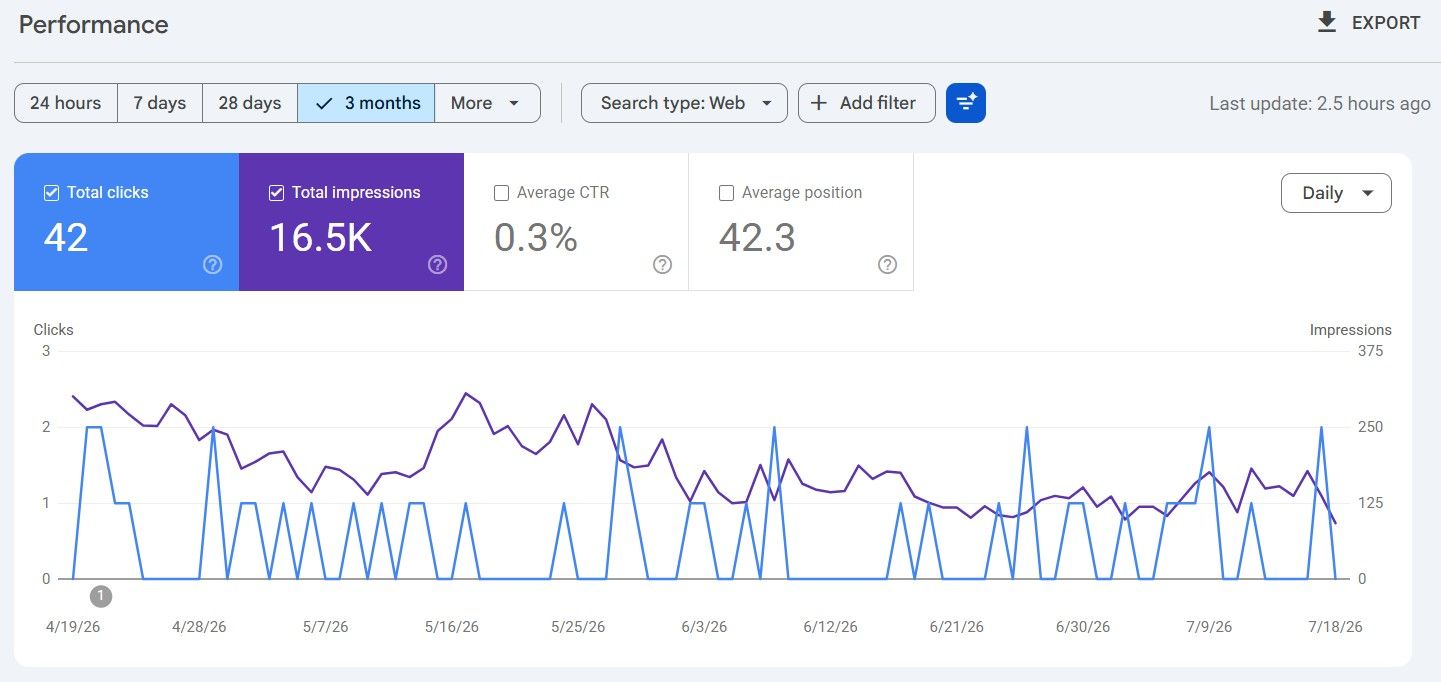
showing how impressions and clicks changed over the three month period
The graph also shows that growth was not steady. Impressions rose and fell throughout the period, while clicks remained low and inconsistent.
That is an important distinction.
An impression means one of my pages appeared in Google search results. A click means someone actually chose to visit it. A site can gain visibility without seeing much traffic if its rankings are still low or if the title is not strong enough to earn the click.
The average position during this period was 42.3, which helps explain the low click-through rate. Most pages were appearing too far down in the search results to attract consistent traffic.
The lesson for me is that impressions are useful, but they are only the beginning. I also need to improve rankings, strengthen my titles, and focus on the posts that are already showing potential.
Blog growth is rarely a smooth upward line. The numbers can rise, fall, and change direction. What matters is using the data to understand what is happening and deciding what to improve next.
To quote Yoda, “Patience you must have, my young Padawan.”
How Long Does It Take to Get Blog Traffic: The Truth No One Likes to Hear
There is no exact timeline that fits every blog.
Many new blogs need three to six months to begin seeing early signs of progress, such as more indexed pages, rising impressions, and occasional clicks. It may take six to twelve months or longer before organic search traffic becomes more consistent.
A realistic timeline often looks like this:
- 0–3 months: Limited indexing, few impressions, and little or no traffic
- 3–6 months: More pages appearing in search, early impressions, and occasional clicks
- 6–12 months: Rankings may begin to improve, leading to more noticeable traffic
- 12 months and beyond: Growth may become steadier as you improve the posts already showing potential and build more useful, related content
Some blogs move faster. Others take longer.
The important thing is to watch what your data is telling you. Check which pages are indexed, which posts are earning impressions, where they rank, and whether those impressions are turning into clicks.
Be patient, but do not wait blindly. Keep improving the parts of your blog that are working and fix the ones that are holding you back.
Your Turn
I hope this post gives you a clearer idea of what to expect while you are waiting for blog traffic to grow. It usually does not happen overnight, but steady progress is possible when you pay attention to what is working and keep improving your content.
What is the biggest challenge you are dealing with right now? Are your posts not getting indexed, are impressions staying low, or are people seeing your pages but not clicking?
Leave a comment and tell me what is happening with your blog. I read every comment, and your question may help me create a future post that gives you a more specific answer.

About the Author: Dan Swords
Dan Swords is a writer, blogger, and content creator with more than 35 years of professional technical writing experience and over 13 years creating content for the web. Through danswords.com, he shares practical advice to help aspiring bloggers and creators get their ideas online. His focus is simple: helping people start and grow a blog with clear writing, engaging content, and practical strategies that actually work.