

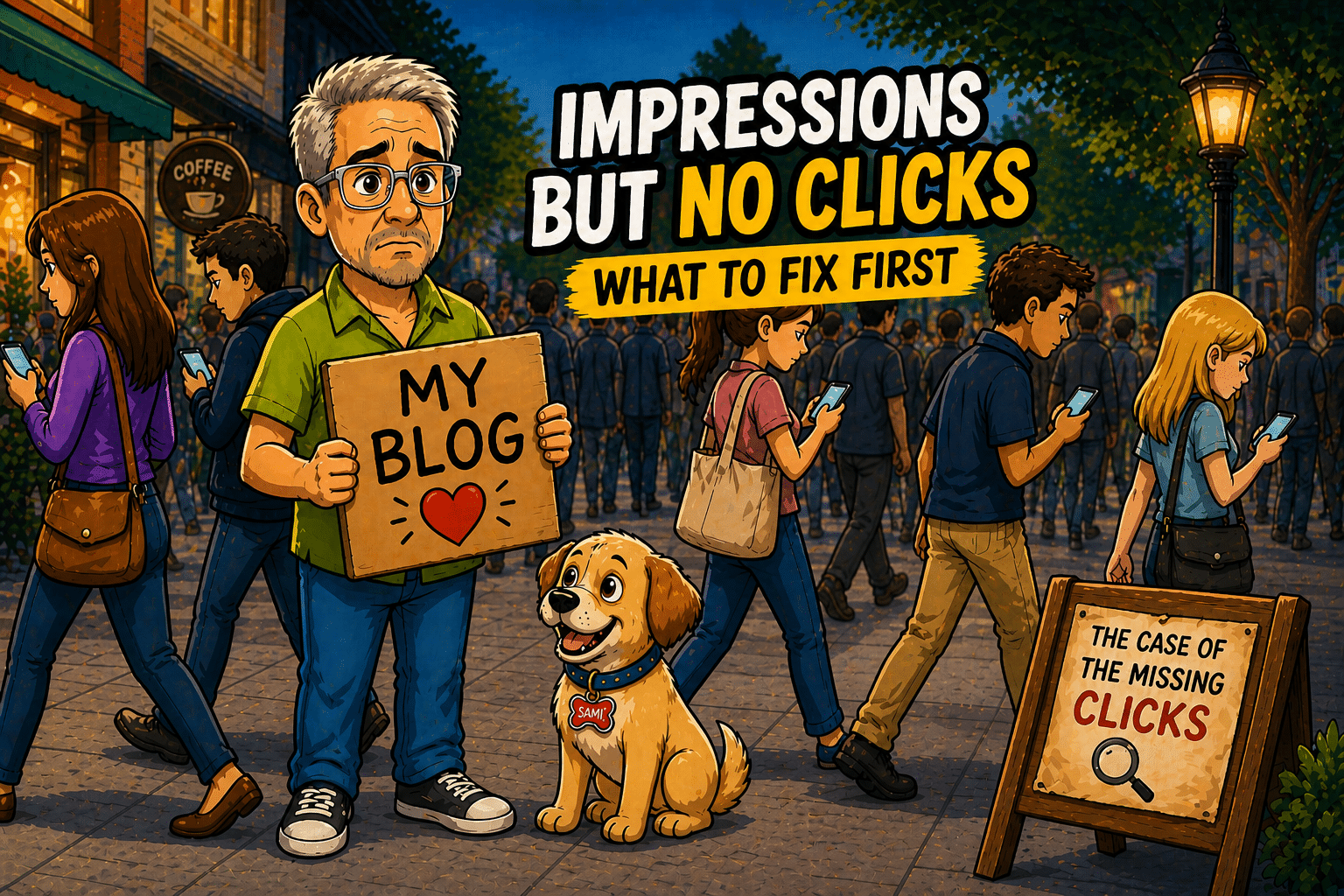
Seeing blog impressions but no clicks means your page is appearing in Google search results, but people are not clicking through to visit it.
That usually comes down to three problems:
- Your title is not earning attention
- Your post does not match search intent
- Your search snippet does not explain why the page is worth visiting
Before rewriting the entire post, check the search queries and average position in Google Search Console. A page ranking around position 40 has a different problem from one ranking around position 7.
If the page ranks low, visibility may be the main issue. If it ranks near the first page but still gets few clicks, the title, search intent, or search snippet deserves closer attention.
The goal is to identify which of the three problems you have before making changes.
Problem #1: Your Title Is Not Compelling Enough
Your title is one of the first things people notice in search results.
If it is too vague, too broad, or too similar to every other result, readers may skip over it even when the content itself is useful.
This often happens when titles are:
- Too generic
- Missing a clear benefit
- Similar to competing results
- Written around the topic instead of the reader’s question
- Accurate but not specific enough
For example:
SEO Tips for Beginners
Compared with:
SEO for Creators Over 50: The Proven Way to Get Found on Google in 2026
The first title tells the reader the general topic. The second gives the reader a clearer idea of what the post will provide.
A strong title should:
- Match the search query
- Describe the content accurately
- Show why the post is useful
- Use clear, specific wording
- Avoid exaggerated promises
👉 A strong title should be accurate, specific, and relevant.
👉 It should also give the reader a clear reason to click.
Before changing the title, check the page’s average position. If the post is ranking around position 40, very few people may be seeing it. If it is ranking near the first page but still getting few clicks, the title deserves closer attention.
Review my approach to writing blog headlines that get clicks before making changes.
Problem #2: Your Post Does Not Match Search Intent
Search intent is the reason behind the search.
Someone typing a question into Google is looking for a specific kind of answer. If your post goes in a different direction, it may still receive impressions, but it is less likely to earn clicks.
For example, someone searches:
But your post is titled:
10 Ways to Increase Blog Traffic
Those topics are related, but they are not the same.
The searcher may first want to understand what is wrong. A list of growth tips skips past that question and moves directly to the solution.
Your topic may also be too broad.
For example:
How to Start a Blog
That topic is highly competitive and usually dominated by large, established websites.
A more specific version might be:
Starting a Blog After 50: How to Share Your Experience Online
The second version speaks to a clearer audience and a more specific topic.
A post may fail to match search intent when:
- The topic is too broad
- The keyword is too competitive
- The article answers a related question instead of the actual query
- The format does not match what searchers expect
- The introduction takes too long to answer the question
- The content does not go far enough to solve the problem
Searchers may be looking for:
- A direct explanation
- A step-by-step tutorial
- A list of ideas
- A comparison
- A timeline
- A solution to a specific problem
Before rewriting the post, review the search queries connected to the page. Then compare those queries with the title, introduction, and main sections.
👉 If the page appears for the wrong searches, the topic or wording may need to change.
👉 If it appears for the right searches but still gets few clicks, the title or search snippet may need more work.
The goal is not only to appear in search, but to appear for the right search.
Problem #3: Your Search Snippet Is Not Helping
Your search snippet is the text that appears beneath the title in Google search results.
Sometimes Google uses the meta description you wrote. Other times, it pulls different text from within the page.
Either way, the snippet should make the value of the post clear.
A weak search snippet may be:
- Too vague
- Repetitive
- Cut off
- Missing the main benefit
- Unclear about what the reader will learn
- Too similar to the title
A stronger snippet should:
- Support the title
- Speak directly to the reader’s problem
- Explain what the post will help them do
- Use clear, natural language
- Give the reader a reason to choose your result
For example:
Getting blog impressions but no clicks? Learn how to check your title, search intent, and search snippet before rewriting the entire post.
That description addresses the problem and tells the reader what the article covers.
👉 Think of the search snippet as a short explanation of why the page is worth visiting.
👉 Do not stuff it with keywords or make promises the post cannot keep.
You should also make sure the introduction answers the main question quickly. Google may pull text from the opening paragraphs when it creates the snippet.
What Most People Get Wrong at This Stage
When impressions rise but clicks stay low, it is easy to assume the content is not good enough.
That often leads bloggers to:
- Rewrite the entire post
- Change the topic
- Remove useful sections
- Start over before understanding the problem
But low clicks do not always mean the post has failed.
The title may be weak.
The content may not match the search.
The search snippet may not explain the value clearly.
Those are three different problems, and each one needs a different fix.
Before making major changes, check:
- Which search queries are creating the impressions
- Where the page ranks for those queries
- Whether the post matches what the searcher wants
- Whether the title and snippet clearly explain the value
👉 Use the data to diagnose the problem before rewriting the content.
👉 A post that already earns impressions may need refinement, not replacement.
I usually give a new post time to be crawled, indexed, and gather enough data before making major changes. But I will fix an obvious mistake, weak title, or clear search-intent problem as soon as I see it.
What to Fix First (Keep This Simple)
Do not try to fix everything at once.
Use this order.
1. Check the Search Queries
Look at the exact searches creating impressions for the page.
Ask:
👉 Does this post answer what the person is actually searching for?
If the queries do not match the purpose of the post, focus on search intent first.
2. Check the Average Position
Ranking position helps you understand how visible the page is.
- Positions 1–10: The title and snippet may be limiting clicks
- Positions 11–20: The title and intent matter, but the page may also need stronger content
- Positions 20 and below: Low visibility is probably a major reason clicks are limited
A low ranking is not one of the three main problems by itself. It is a clue that the post may be too broad, too competitive, incomplete, or poorly matched to the search.
3. Improve the Title
If the page ranks high enough to be noticed but gets few clicks, review the SEO title.
Make it:
- Clear
- Specific
- Relevant to the query
- Accurate
- Useful to the reader
4. Match the Search Intent
Make sure the title, introduction, and main sections answer the same question the searcher asked.
If the topic is too broad, narrow it.
If the page answers a related question, refocus it.
If the reader expects a tutorial, list, or explanation, provide that format.
5. Strengthen the Search Snippet
Write a meta description that supports the title and explains why the post is useful.
Also make sure the opening paragraph gives Google clear text to use if it creates its own snippet.
6. Improve the Content Only When Needed
If the page ranks low because the article is incomplete or weaker than competing results, improve the content.
You may need to:
- Add missing information
- Answer the main question earlier
- Include better examples
- Improve internal links
- Narrow the topic
- Remove sections that do not help the reader
7. Give New Posts Time
A new post may need time to be crawled, indexed, and gather enough impressions to reveal a pattern.
Do not make major changes after only a few days unless you find an obvious problem.
👉 Check the query and ranking position first. Then fix the title, search intent, or search snippet based on what the data shows.
Questions You Might Be Asking Right Now
Why am I getting impressions but no clicks on my blog?
This usually means your content is showing up in search results, but something isn’t convincing people to click. The most common reasons are weak titles, mismatched search intent, or ranking too low on the page.
If you’re still trying to understand how rankings actually work, it helps to step back and look at what matters most when it comes how to rank your blog on Google.
Are impressions a good sign if I’m not getting traffic yet?
Yes—impressions are an early signal that your content is being picked up by Google.
It means your blog is moving in the right direction, even if the results aren’t there yet. The gap between impressions and traffic is completely normal, especially in the early stages.
If you want a realistic timeline of how this usually plays out, it helps to understand how long it really takes to get blog traffic.
Should I rewrite my blog post if it’s not getting clicks?
Not right away.
Most of the time, the issue isn’t the full post—it’s how the post is being presented in search results. Start by improving your title, adjusting your meta description, and making sure your content matches what people are searching for.
If your blog still isn’t gaining traction after that, you might want to take a broader look at why your blog is not getting traffic and what to adjust next.
What matters more: impressions or clicks?
They work together.
Impressions tell you your content is being seen. Clicks tell you your content is being chosen.
You need both—but impressions usually come first. Once you have visibility, you can start improving how often people click through.
Is it normal for a new blog to get impressions without clicks?
Yes, completely.
This is one of the most common early stages of blogging. Your content is being tested in search results, and it takes time to move into positions where people actually click.
If you’re also working through consistency and showing up regularly, that plays a big role in long-term growth. Staying consistent with content creation is often what separates blogs that eventually grow from the ones that stall out.
Let’s Wrap This Up: Blog Impressions But No Clicks
Blog impressions but no clicks can feel discouraging, but they give you useful information.
Your page is appearing in search. Now you need to understand why those impressions are not becoming visits.
In most cases, the issue comes down to three things:
- The title is not earning attention
- The post does not match search intent
- The search snippet does not explain the value clearly
Start with Google Search Console. Review the search queries and average position, then make one focused change at a time.
Do not rewrite everything just because clicks are low. Use the data to identify the real problem and improve the part that is holding the page back.

About the Author: Dan Swords
Dan Swords is a writer, blogger, and content creator with more than 35 years of professional technical writing experience and over 13 years creating content for the web. Through danswords.com, he shares practical advice to help aspiring bloggers and creators get their ideas online. His focus is simple: helping people start and grow a blog with clear writing, engaging content, and practical strategies that actually work.