

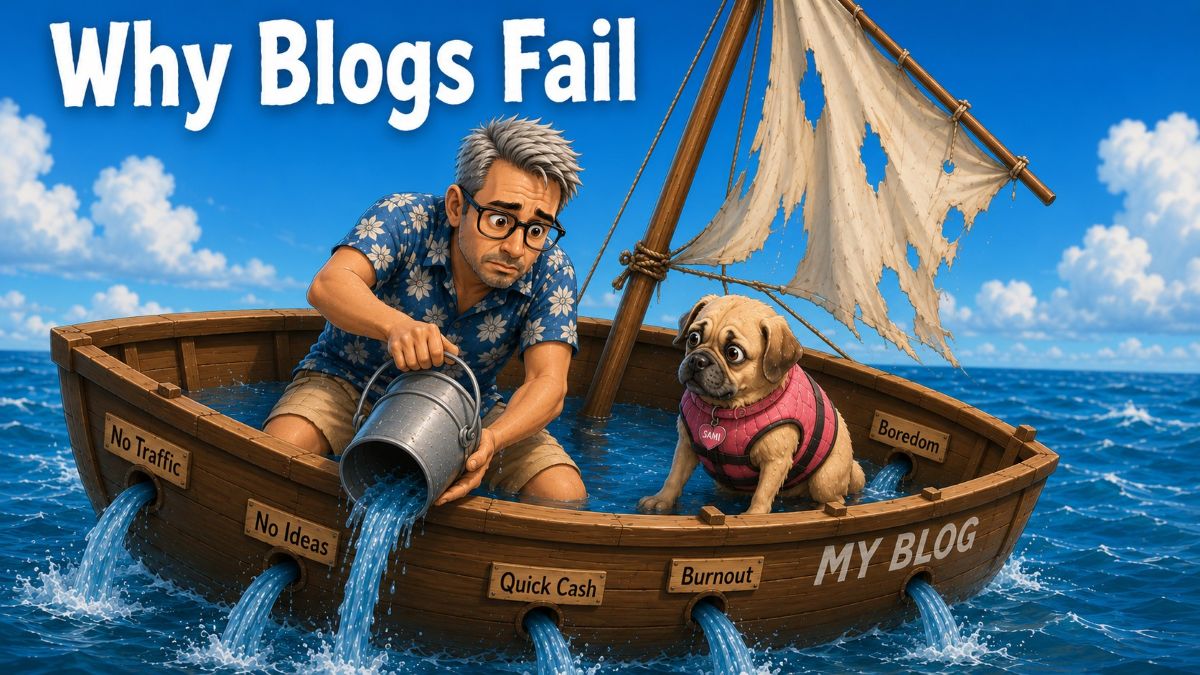
Creating a blog is not like the movie Field of Dreams. If you build it, they will not come. The reality behind why blogs fail often has little to do with the quality of the writing. More often, the writer has bitten off a little more than they can chew. Blogging takes time, patience, and a lot of hard work to grow.
Most new bloggers begin with plenty of enthusiasm. They choose a domain name, build a website, publish their first few posts, and imagine readers arriving from Google and social media.
Then reality sets in.
The visitor count barely moves. Writing takes longer than expected. Social media becomes another task on an already crowded list. The blog that once felt exciting starts to feel like work.
This does not mean the blogger lacks talent or has nothing worthwhile to say. Many promising blogs disappear because the person behind them was not prepared for the amount of time, creativity, and persistence required to keep going.
Understanding why blogs fail can help you recognize the warning signs before frustration turns into quitting.
Why Blogs Fail: The Writer Gets Bored
Boredom is one of the most overlooked reasons for why blogs fail.
Starting a blog is fun because everything is new. You get to choose a domain name, experiment with colors, design the homepage, and publish your first articles. Even checking your visitor count can feel exciting when you are waiting for the first readers to arrive.
Eventually, the newness wears off.
Writing another post starts to feel less like a creative project and more like an assignment. The blogger who once had a notebook full of ideas now struggles to finish a single article.
There are several reasons this happens.
You may have chosen a topic because it seemed profitable, rather than it being a topic that you genuinely enjoyed. You may have selected a niche that was too narrow to support years (or even months) of ideas. You may also be tired of following the same writing formula every week.
The truth is that blogging is not for everyone.
Some people enjoy writing occasionally, but do not enjoy maintaining a publishing schedule. Others love creating content, but dislike the technical work, promotion, and constant pressure to produce something new every week.
There is nothing wrong with discovering that blogging is not the right fit for you. But that does not always mean it is time to quit. Sometimes it means you need to make a course adjustment.
What revitalized my website was the creation of Dan & Sami and the development of my new featured images and Pinterest pins. Half the fun of writing a new post is coming up with a good featured image using Dan & Sami.
The image is no longer something I add after the article is finished. It has become part of my creative process.
That change did not happen all at once. My approach evolved as I experimented with different designs, characters, and ideas. I shared that progression in The Thinker, the Puggle, and the Evolution of My Featured Images.

When writing begins to feel stale, or feel more like writing a term paper, try changing part of the process.
Create a recurring character.
Try a different post format.
Add original illustrations.
Tell a personal story.
Record a video.
Turn a lesson into a comic.
Write somewhere other than your usual desk.
Do something different to break the doldrum.
Why Blogs Fail: No One Visits the Blog
Few things are more discouraging than publishing a post and realizing that no one has read it.
You spend hours researching, writing, editing, formatting, and creating the content that you love. You hit publish, check your analytics, and see a flat line.
Been there, done that!!
A lack of visitors is one of the biggest discouraging factors as to why blogs fail, but low traffic does not automatically mean the content is bad.
It may simply mean that the blog is new and no one (not even Google) knows it is out there yet.
New websites have no established audience, no backlinks, and no authority with search engines. Google may need time to discover the site, understand its content, and decide where the pages belong in the search results.
A search engine can crawl a page without adding it to its index. When that happens, the article has almost no chance of appearing in Google search results. I’ve dealt with this exact problem today, and I write about the changes I’ve implement to fix why a blog post is crawled but not indexed. With the explosion of AI created content, Google is looking to remove low-value and thin content from it’s rankings. Be sure your post is doesn’t get swept up in the low-value purge.
Keyword competition can also keep a good article buried.
A new blogger might try to rank for a broad phrase that is already dominated by major websites. Most of these site have large content teams, thousands of backlinks, and years of authority. With a playing field like this, excellent articles like the ones you create may never reach the first page against this that level of competition.
Instead of targeting the broadest phrase possible, look for more specific questions that match what your ideal reader is actually searching for. A longer keyword can be more valuable when you have a realistic chance of ranking for it.
You also need a way to help people discover your work.
That may include:
- Improving your headlines
- Adding internal links between related articles
- Creating Pinterest pins
- Sharing useful excerpts on social media
- Producing related YouTube videos
- Updating older posts
- Writing about more specific search questions
I have chosen to put more effort into Pinterest because visual content gives each blog post another opportunity to reach potential readers. I explain the thinking behind that decision in Why I’m Choosing to Focus More on Pinterest Traffic.
You do not need to promote your blog on every available platform. That can quickly become tiresome. Choose one or two methods that fit your content, personality, style, and available time.
A quiet beginning is normal. The mistake is assuming that a slow start proves the website will never grow.
Why Blogs Fail: You Run Out of Ideas
Writer’s block is real, but it is not a closed door.
It is usually a temporary block that you can work around. The more pressure you put on yourself to produce the perfect idea, the perfect content, the harder it can become to reach that goal.
Sometimes the best solution is to step away from the screen.
Go for a walk.
Change your writing location.
Put some music on in the background.
Visit a coffee shop, library, park, or another place where your surroundings feel different.
Just do something different.
A small change can interrupt the mental loop that keeps you staring at an empty page.
Running out of ideas is another common reason why blogs fail, but it rarely means there is nothing left to write about. More often, the writer needs new sources of inspiration.
Read books related to your subject. Listen to podcasts. Read other blogs. Watch videos. Browse online discussions to see which questions people keep asking. This can lead to a plethora of new content. (See how I worked that into this post!!)
AI can be your new friend.
You can also use AI to brainstorm topics, organize scattered ideas, create outlines, or find different angles for a subject you have already covered.
AI does not need to replace your voice or write the entire article. It can act as a creative partner that helps you move past the blank page.
The right tools can make the process easier without requiring a complicated or expensive setup. I cover several practical options in Content Creation Tools for Beginners: What You Actually Need.
It also helps to keep an idea bank.
Whenever you think of a possible title, question, personal experience, or problem, write it down. Do not trust yourself to remember it later. (Ha, that’s another one I’ve learned the hard way!!) A notes app, spreadsheet, document, or notebook will work.
Most importantly, think outside the box and try new things.
There are no steadfast rules saying that every blog post must follow the same structure. You can publish a tutorial, opinion piece, experiment, case study, personal story, list, interview, or behind-the-scenes look at your process.
Do not be afraid to experiment. Some ideas will work better than others, but every experiment teaches you something about the kind of content you enjoy creating.
Why Blogs Fail: It Becomes Too Much Work
Blogging takes a lot of time, but it does not have to consume ALL of your time.
A good blog post will involve research, outlining, writing, editing, image creation, formatting, internal linking, metadata, promotion, and later updates. And a ton of other stuff…
Then there are plugin updates, spam comments, technical problems, analytics, email, and social media.
When all of those tasks pile up, blogging begins to feel like a second full-time job. That is one of the clearest reasons why blogs fail.
The solution is not always to work faster or working longer. Sometimes the solution is to create a more manageable system.
Start by publishing at a pace you can realistically maintain.
There is no rule saying you must publish three times a week. One useful article every week is better than an aggressive schedule that leaves you exhausted and resentful.
Writing posts in advance can will remove a lot of the pressure.
Instead of finishing every article the night before it goes live, build a small buffer of completed posts. WordPress allows you to schedule each article for a future date, so the site looks like you are writing content when you are actually kicking back and catching some rays.
The same approach works with social media.
You can batch-create several social posts or Pinterest pins during one work session (for me it’s Saturday) and schedule them to be released later. Batch posting keeps you from stopping what you are doing every day to create another individual post.
A content calendar can help you see what is coming and spread the work across several days. It does not need to be complicated. A basic calendar showing the topic, writing date, publication date, and promotional tasks may be enough.
I explain how to organize this process in How to Create a Content Calendar: 4 Easy Steps.
Evergreen content can also reduce the pressure to constantly chase new topics.
An evergreen article answers a question that will remain useful long after its publication date. It can continue attracting readers, support newer posts through internal links, and be shared again in the future. That long-term value is why evergreen content matters for building a sustainable website.
Blogging will always require work. But the goal is to build a process that fits into your actual life instead of allowing the website to take over every free hour.
Why Blogs Fail: The Blog Has No Clear Direction
Every blog needs a purpose.
Readers should be able to visit your homepage and understand what you create, who you create it for, and why they should keep reading.
A blog does not have to cover only one tiny subject, but its content should be connected by a clear idea.
Without that direction, the writer may jump from one unrelated topic to another. One week the blog is about recipes, the next week it is about cryptocurrency, and the following week it is about home repair.
That confusion is another explanation for why blogs fail. Readers (and Google) do not know what to expect, and the writer has no clear path for deciding what to publish next.
One way to test a potential direction is to identify 25 pain points within the niche you want to cover.
What frustrates the audience? What are they trying to learn? What mistakes are they making? What is keeping them from reaching their goal?
Next, turn those pain points into 25 questions.
Then ask whether you can create 25 useful answers.
If you can identify those problems, questions, and answers, you have the beginnings of a defined path. You also have a strong list of about a half a year’s blog posts.
Your direction can change over time.
A blog is not a lifetime contract with the subject you chose on the first day. Your interests may shift, your audience may respond to unexpected topics, and new creative opportunities may appear.
However, changing direction every few weeks because traffic is slow will prevent the site from gaining momentum.
Blog traffic usually takes longer to develop than new bloggers expect. The honest timeline for getting blog traffic is often measured in months or years rather than days.
Give your direction enough time to develop before deciding it has failed.
Why Blogs Fail: The Allure of Quick Cash
There are popular podcasts, books, videos, and websites that make blogging sound simple.
Create a website. Publish a few articles. Add affiliate links. Watch the money roll in.
What they often leave out is how long it takes for a blog to grow.
The promise of quick cash is one of the most damaging reasons why blogs fail because it creates unrealistic expectations before the first post is even published.
A blog can make money, but it needs visitors.
You can have a thousand affiliate links across your website, but if no one shows up and clicks on those links, you will not make a cent.
That is why I continue to preach the importance of useful content and a clear voice.
Your articles need to answer real questions. Your articles need to help your readers. Your headlines need to attract your reader’s attention. Introductions need to keep people reading, and the information inside need to give the reader a reason to trust you.
These are the qualities of a great blog.
Quality alone does not guarantee traffic, but low-quality content gives readers no reason to stay after they find you.
Build a useful collection of articles first.
Improve your search visibility.
Promote the content.
Learn which pages attract visitors and which subjects connect with your audience.
Once people begin visiting your website, you can add relevant affiliate links where they genuinely help the reader.
There is nothing wrong with wanting to earn money from a blog. The problem begins when money is the only reason you created the blog.
How to Find Simple Blog Post Ideas When You Feel Stuck
Running out of ideas does not always mean you are out of things to say.
Sometimes it just means you are trying to think too big.
When you feel stuck, do not start by asking, “What huge topic can I write about next?” That question can make blogging feel harder than it needs to be.
Start smaller. Look for some simple blog post ideas to keep your momentum going.
Look for one simple problem your reader might have and turn that into a blog post.
For example, instead of writing about “blogging,” you could write about:
- how to come up with blog post ideas
- how to plan one week of content
- how to update an old blog post
- how to write a better headline
- how to stay motivated when your blog is not growing
Those are simple ideas, but they are useful because each one answers a real question.
You can also look at your own blogging struggles. What confused you when you started? What mistake did you make last month? What problem did you finally figure out?
That kind of experience can become helpful content for someone else.
This is why I like keeping a simple blog post idea list. You do not need a complicated system. A notebook, a notes app, or a basic content calendar is enough. The goal is to capture ideas before they disappear.
If you want to make this even easier, create a small series around one bigger topic.
For example, a series about keeping your blog alive could include posts about why blogs fail, how to create a content calendar, how to find blog post ideas, how to stay consistent, and how to avoid burnout.
Now you are not trying to come up with random ideas every week. You are building connected posts that support each other.
Let’s Wrap This Up
The real reasons why blogs fail are usually less dramatic than people imagine.
Most bloggers do not suddenly decide that everything they created was worthless. They gradually stop writing. One missed post becomes a month without publishing. Drafts remain unfinished. The website stays online and the writer no longer feels connected to it.
Boredom, low traffic, a lack of ideas, too much work, unclear direction, and unrealistic financial expectations can slowly wear down even a promising blogger.
None of those problems automatically means the blog should end.
A bored writer can explore a more creative format. A site with no traffic can improve its keywords and promotion. A blogger with no ideas can find inspiration in books, podcasts, AI, and personal experiences. An overwhelmed writer can publish less often and schedule content in advance.
The most important lesson about why blogs fail is that blogging requires more than the ability to write.
It requires patience, flexibility, a clear purpose, and a workload you can realistically maintain.
You do not need to publish every day. You do not need to promote your work on every platform. You do not need thousands of visitors during your first month.
You need a reason to continue, a direction you understand, and a process you can maintain long enough to give the blog a fair chance.
Please be sure to follow me on Instagram for more behind scenes stuff.

About the Author: Dan Swords
Dan Swords is a writer, blogger, and content creator with more than 35 years of professional technical writing experience and over 13 years creating content for the web. Through danswords.com, he shares practical advice to help aspiring bloggers and creators get their ideas online. His focus is simple: helping people start and grow a blog with clear writing, engaging content, and practical strategies that actually work.