

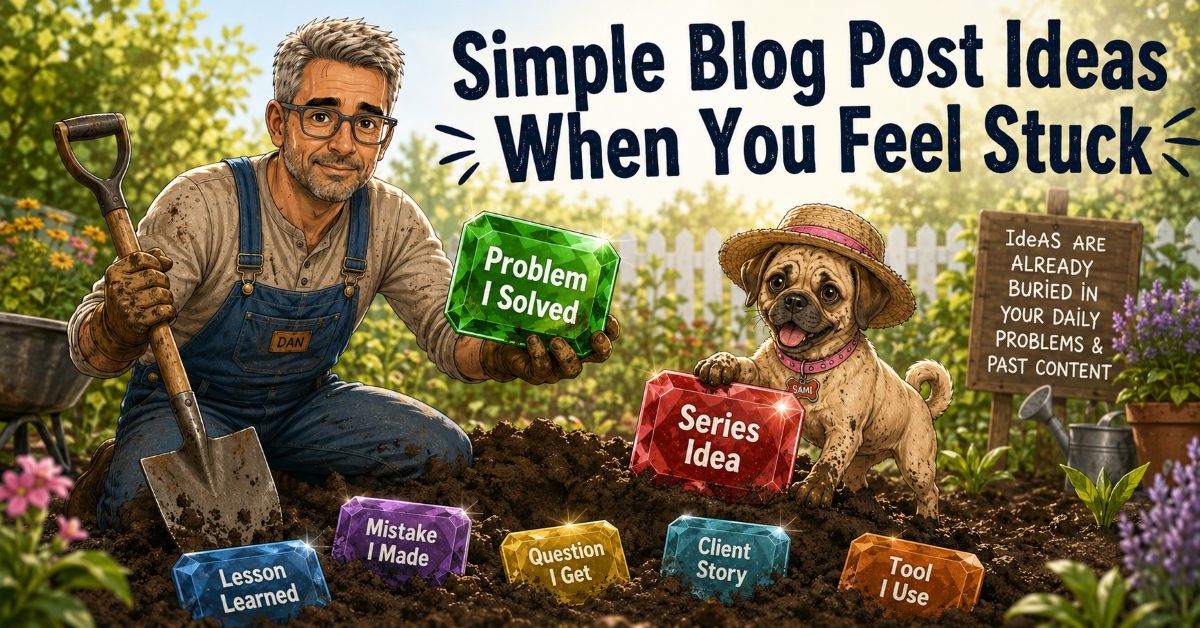
Sometimes the hardest part of blogging is not writing the post. It is deciding what the post should be about. That’s why you need simple blog post ideas you can use when you feel stuck.
Every blogger has been there, staring at a blank screen while the cursor blinks back at you.
Blink.
Blink.
Blink.
“Are you going to type something or what?”
Do not let that blinking cursor be the reason your blog stops moving forward. A lack of ideas is one of the reasons blogs fail, but it does not have to be the reason yours does.
The good news is that you do not always need a brand-new idea. Sometimes your next blog post is already hiding inside a problem you are trying to solve, an older post that needs more work, or a topic you keep coming back to again and again.
Here are three simple blog post ideas to help you start writing again.
Turn Your Own Struggles Into Blog Posts
This is great fuel for almost any blogging or content creation niche.
One of the main reasons a blog post works is because it helps solve a problem the reader is having. But here is the question: Why can’t that reader be you?
Why can’t you solve a problem you are having and turn that experience into a blog post?
I did exactly this in my blog post, Blog Post Crawled but Not Indexed? What Actually Fixed It.
I had a few posts that I thought were pretty good. Maybe not literary masterpieces, but at least useful enough to show up in Google.
But Google had other ideas.
The posts were crawled, but they were not indexed. They were just sitting there doing nothing. That gave me a reason to investigate the problem, figure out what was going on, and turn what I learned into a blog post.
That is the key.
When you are dealing with a real problem, you already have the beginning of a useful article. You can explain what happened, what you tried, what worked, what did not work, and what someone else can learn from it.
Think about the problems you run into every day.
Gardening: How I Cleaned Up Black Spots on My Roses
Cooking: How to Cook a Steak on the Stove
Pets: How to Housebreak a Puppy: Here’s What Worked for Me
AI: How Do I Get AI to Follow My Instructions?
Blogging: Why Is My Blog Post Crawled but Not Indexed?
You do not need to make every post sound perfect before you start. Just pay attention to the problems you are already trying to solve.
Write them down.
Save them.
Use them for your next blog post.
Update or Expand an Older Post
Another way to find blog post ideas is to look at what you have already published.
Sometimes you do not need a new idea. You need a better version of an old idea.
Find a post that is already live but could use a little work. Maybe it needs a stronger introduction. Maybe the examples are thin. Maybe you could add a missing section, answer a few common questions, or explain the topic in a clearer way.
Blog posts are not a one-and-done kind of thing. Just because a post is published does not mean it cannot be improved.
I did this with 10 Qualities of a Great Blog Post That Drives Results.
That topic still had value, but there was room to make it stronger. I looked at the post again, sharpen the points, add better examples, and made the advice more useful for the reader.
This is also a good way to get the creative juices flowing again. Once you start improving an older post, you may find another idea hiding inside it.
For example, maybe one section deserves its own full article. Maybe one point needs more explanation. Maybe your opinion has changed since you first wrote the post.
Those “Aha!!” moments can become your next blog post.
So when you feel stuck, go back through your older content and ask:
Can this post be updated?
Can this topic be expanded?
Can I explain this better now?
Can one section become its own post?
Can I challenge something I wrote before?
That is how an older blog post can help you create something new.
Create a Series
This is one of my favorite ways to keep writing: create a blog series.
A series gives you a built-in direction. You are not starting from scratch every time because the larger theme is already there. You just need to decide what part of the topic you want to cover next.
I have done this with Building the Dream.
That series gives me a place to write about the real process of keeping this blog moving. I talk about the good parts, the frustrating parts, the small wins, and the days when the visitor count is not exactly impressive.
One post in that series, The Dream Is Big, Even if Last Tuesday’s Visitor Count Was Small, came from that exact place.
It was about continuing to blog, write, and publish even when the visitor count and impressions were low. That is not always easy, but it is part of the process. And because it is part of the process, it can become content.
I am also using this idea with the Keeping Your Blog Alive series.
This series gives me a way to write about consistency, content planning, and the things bloggers can do when they want to keep going, but feel stuck.
That is what makes a series so useful. It gives your blog a repeatable structure.
You can create a series around almost anything:
A weekly progress update.
A beginner lesson series.
A behind-the-scenes series.
A “what I learned” series.
A mistakes-and-fixes series.
A challenge series.
A blog series helps readers know what to expect, but it also helps you as the writer. It gives you a reason to return to the same larger topic from different angles.
And when you have no blog post ideas, that can make a huge difference.
Start With the Featured Image
I know this may sound a little strange, but one thing I do when I feel stuck is think about the featured image first.
For me, that usually means asking, “What new Dan & Sami featured image can I create?”
Sometimes the image idea comes before the blog post idea.
I did this with H1 H2 H3 Tags: The Simple Way to Structure a Blog Post and The Thinker, the Puggle, and the Evolution of My Featured Images.
Both of those posts started with a visual idea.
That may not work for every blogger, but it works for me because images help me think about the story behind the post. Once I can picture the scene, I can usually figure out what the article is trying to say.
If you are a visual thinker, this may help you too.
Instead of asking, “What should I write about?”
Ask, “What image would make this idea interesting?”
That question can lead you back to the article.
Let’s Wrap This Up: Simple Blog Post Ideas When You Feel Stuck
When you feel stuck, you do not need to panic or chase random ideas from a giant list.
Start with what is already in front of you.
Look at the problems you are working through. Look at the older posts that could be stronger. Look at the topics you keep coming back to again and again. Those are not dead ends. They are blog post ideas waiting to be written.
Your own struggles can become helpful posts.
Your older articles can become stronger resources.
Your recurring themes can become a blog series.
And sometimes, even a featured image can give you the spark you need to start writing again.
The next time the cursor starts blinking at you, do not ask, “What should I write about?”
Ask a better question.
“What problem can I help someone solve today?”
That one question can get you moving again.

About the Author: Dan Swords
Dan Swords is a writer, blogger, and content creator with more than 35 years of professional technical writing experience and over 13 years creating content for the web. Through danswords.com, he shares practical advice to help aspiring bloggers and creators get their ideas online. His focus is simple: helping people start and grow a blog with clear writing, engaging content, and practical strategies that actually work.